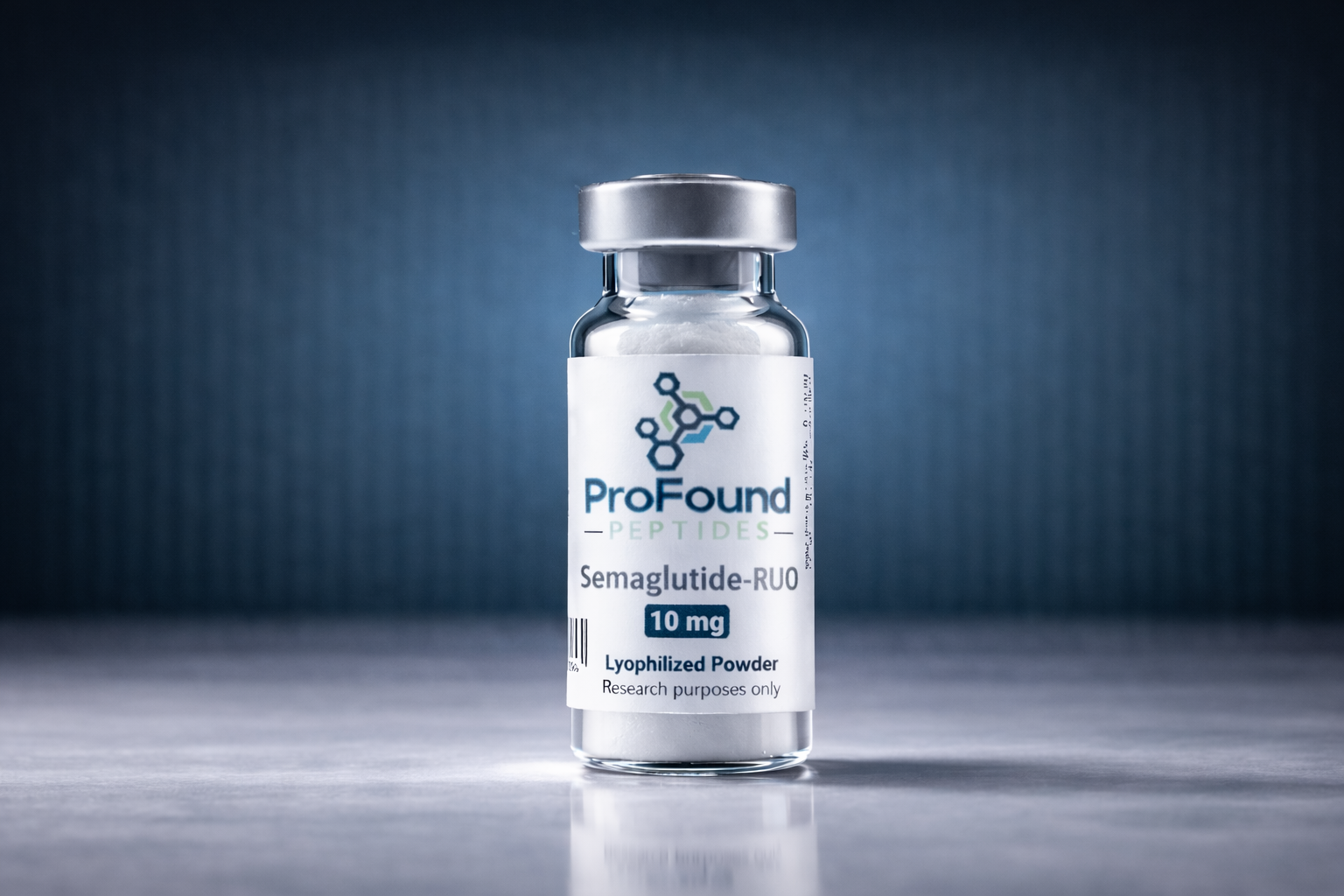
Product Specifications
| Also Known As | LY900018 / GLP SM / Ozempic active compound / Wegovy active compound |
| CAS Number | 910463-68-2 |
| Molecular Formula | C187H291N45O59 |
| Molecular Weight | 4,113.58 Da |
| Sequence Length | 31 amino acids |
| Homology to Native GLP-1 | 94% |
| Vial Size (nominal) | 10mg |
| Form | White lyophilized powder |
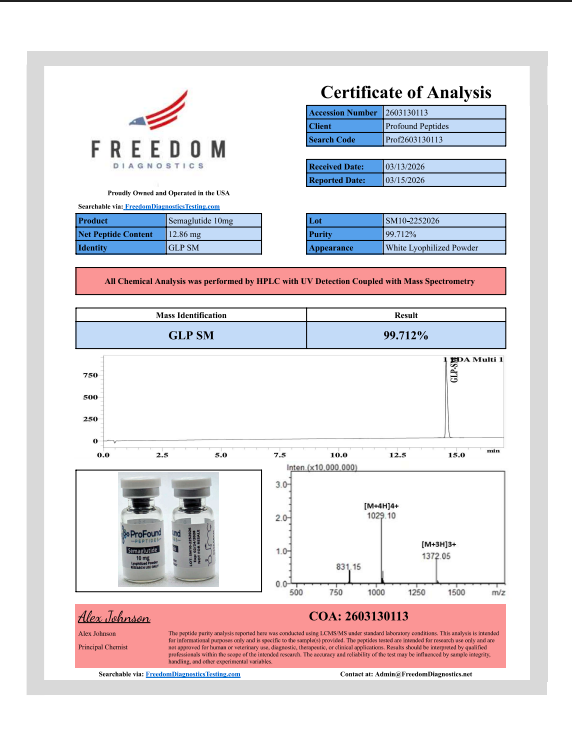
| Purity (this batch) | 99.712% — Freedom Diagnostics COA: 2603130113 |
| Net Peptide Content | 12.86mg confirmed |
| Testing Method | HPLC with UV Detection + Mass Spectrometry |
| Lot Number | SM10-2252026 |
| COA Accession | 2603130113 |
| Search Code | Prof2603130113 — verifiable at FreedomDiagnosticsTesting.com |
| Identity Confirmed | GLP SM — Mass Spectrometry confirmed |
| Receptor Target | GLP-1R only (monoagonist) |
| Key Modifications | Aib at position 8 (DPP-4 resistance), C18 diacid at Lys26 via gamma-Glu-(AEEA)2 spacer (albumin binding), Arg34 substitution |
| Half-life | ~168 hours (~7 days) in research models |
| Albumin Binding | >99% in plasma |
| Working Stock | ~6.43mg/mL at 2mL BAC water (~2.57mL usable from 12.86mg net content) |
| Long-term Storage | -20°C, sealed, up to 24 months |
| Post-reconstitution | 2 to 8°C, use within 28 days — do not refreeze |
| Reconstitution Solvent | Bacteriostatic water (preferred) |
| Intended Use | In vitro laboratory research only |
| SKU | PP-207 |
Certificate of Analysis
Freedom Diagnostics tested this batch with no input from Profound Peptides on the outcome. Search accession number 2603130113 or search code Prof2603130113 at FreedomDiagnosticsTesting.com to read the full report yourself before ordering.
| Purity | 99.712% |
| Testing Method | HPLC with UV Detection + Mass Spectrometry |
| Identity | GLP SM — confirmed |
| Net Peptide Content | 12.86mg |
| Lot Number | SM10-2252026 |
| COA Accession | 2603130113 |
| Search Code | Prof2603130113 |
| Testing Lab | Freedom Diagnostics (USA — independent) |
| Principal Chemist | Alex Johnson |
| Received | 03/13/2026 |
| Reported | 03/15/2026 |
How Semaglutide Works
Semaglutide is a synthetic analog of glucagon-like peptide-1 (GLP-1), an incretin hormone secreted by intestinal L-cells after eating. It shares 94% structural homology with native GLP-1 but carries three targeted molecular changes that extend its half-life from 2 minutes to approximately 7 days. It binds and activates GLP-1R only. That single-receptor specificity is what makes it the right compound when your study needs to isolate GLP-1 receptor-mediated outcomes without other incretin receptor signals in the mix.
What GLP-1R Activation Does
GLP-1R activation releases insulin in a glucose-dependent way. Insulin secretes only when blood glucose is elevated, not at baseline. At the same time it suppresses glucagon, slows gastric emptying, and signals satiety through vagal afferents to the hypothalamic arcuate nucleus and nucleus tractus solitarius. In pancreatic islet models, GLP-1R activation promotes beta-cell proliferation and reduces apoptosis under glucotoxic conditions. GLP-1R is expressed in the heart, kidneys, liver, and brain, which is why the clinical literature documents cardiovascular, renal, and neuroprotective effects well beyond glycemic control.
Three Structural Changes That Create the 7-Day Half-Life
| Aib at position 8 | Replaces alanine with alpha-aminoisobutyric acid. The steric bulk physically blocks DPP-4 from cleaving the peptide at that site. Without this substitution, DPP-4 degrades the peptide within minutes regardless of any other modification. |
| Arg34 substitution | Replaces lysine at position 34 with arginine, leaving only one lysine (Lys26) in the sequence. This directs the fatty acid attachment to Lys26 and prevents acylation at other sites. |
| C18 diacid at Lys26 via gamma-Glu-(AEEA)2 | An octadecanedioic acid chain through a hydrophilic spacer creates reversible, non-covalent albumin binding at over 99% in plasma. Albumin has a half-life of approximately 19 days and the kidney cannot filter it, extending Semaglutide’s circulation time to roughly 7 days. |
Key Values for Assay Design
| Receptor target | GLP-1R only |
| Half-life | ~165 to 168 hours (~7 days) |
| Albumin binding | >99% in plasma |
| Volume of distribution | ~12.5 liters |
| Peak plasma concentration | 1 to 3 days post-dose |
| Steady-state (weekly dosing) | 4 to 5 weeks |
| DPP-4 resistance mechanism | Aib at position 8 |
Research Applications
Six active research areas where Semaglutide RUO 10mg is in use. Each entry states what researchers study with this compound and the specific published evidence behind it.
- Type 2 diabetes and glucose homeostasis. The SUSTAIN Phase 3 program across nine trials established HbA1c reductions and weight loss superiority over multiple comparators with a low hypoglycemia profile. For db/db mouse models, streptozotocin-induced T2D protocols, or high-fat diet rodent studies measuring glucose clamp endpoints, Semaglutide provides the most comprehensive single GLP-1R receptor reference dataset of any compound in this class.
- Obesity and body composition. The STEP-1 trial showed 14.9% mean weight reduction at 68 weeks with Semaglutide 2.4mg weekly versus 2.4% on placebo in adults with BMI 30 or above. For rodent obesity models where your study question requires a clean, single-receptor GLP-1R signal, Semaglutide delivers consistent and reproducible weight reduction with the strongest published evidence base in its class.
- Cardiovascular outcome research. SUSTAIN-6 showed a 26% MACE reduction (HR 0.74, 95% CI 0.58 to 0.95) in high cardiovascular risk T2D patients over 104 weeks. The SELECT trial extended that finding to non-diabetic overweight and obese populations with a 20% MACE reduction (HR 0.80, 95% CI 0.72 to 0.90) across 17,604 participants. Semaglutide is the only GLP-1 monoagonist with completed cardiovascular outcome data in both diabetic and non-diabetic populations.
- Kidney disease and renoprotection. The FLOW trial showed a 24% reduction in major kidney disease events in T2D with CKD over a median of 3.4 years. The trial stopped early at a pre-specified interim analysis because of significant efficacy. GLP-1R expression in the kidneys drives direct renoprotective effects that work independently of glucose and weight changes.
- Hepatic steatosis and MASH. The FDA approved Semaglutide for metabolic dysfunction-associated steatohepatitis (MASH) with moderate-to-advanced liver fibrosis in 2025. Phase 2 data showed improved liver enzyme levels, reduced steatosis, and decreased liver stiffness. GLP-1R activation reduces hepatic lipid accumulation through direct receptor-mediated effects and improved insulin sensitivity.
- Neuroprotection and neurodegeneration. A 2024 systematic review confirmed neuroprotective effects across multiple preclinical rodent and cell-line models, including reduced amyloid-beta accumulation, protection of dopaminergic neurons, and improved cognitive function in Alzheimer’s and Parkinson’s disease models. GLP-1R expression in neurons and glial cells throughout the CNS is the receptor basis for these effects.
How Semaglutide Compares to Other Incretin Research Peptides
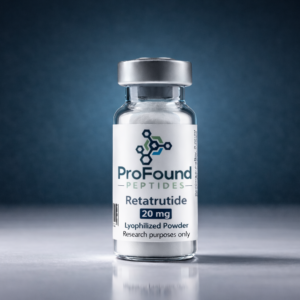
| Semaglutide RUO 10mg | Tirzepatide RUO 10mg | Retatrutide RUO 20mg | |
| Receptor targets | GLP-1R only | GLP-1R + GIPR | GLP-1R + GIPR + GCGR |
| Receptor count | 1 | 2 | 3 |
| GCGR activation | No | No | Yes |
| Half-life | ~168 hrs (~7 days) | ~120 hrs (~5 days) | ~144 hrs (~6 days) |
| Mean weight reduction | ~14 to 17% (STEP) | ~20 to 22% (SURMOUNT) | ~24% (Phase 2) |
| Evidence phase | Phase 3 complete | Phase 3 complete | Phase 3 ongoing |
| Choose this when… | Your study isolates GLP-1R mechanisms and needs a single-receptor reference with the longest half-life and most complete Phase 3 evidence base | Your study needs GIP and GLP-1 co-activation in a single-arm or pilot format | Your study needs the broadest multi-pathway metabolic effect including GCGR thermogenesis |
Storage and Reconstitution
Before Opening
Pull the vial from -20°C and let it sit at room temperature for 10 to 15 minutes. A cold vial draws condensation when it contacts ambient air. That moisture reaches the lyophilized powder through the stopper before you add your solvent. Semaglutide is hygroscopic, so equilibrating in a dry room environment first limits moisture uptake before reconstitution.
Reconstitution
Add 2mL of bacteriostatic water slowly down the inside wall of the vial. Tilt it so the stream contacts the glass first, not the powder. Gently roll for 30 to 60 seconds. Do not vortex or shake. The solution is clear when fully dissolved. Persistent cloudiness after 90 seconds means you should request a replacement vial.
At 2mL you get a 6.43mg/mL working stock from the 12.86mg confirmed net content. For higher concentration assays, 0.5 to 1% acetic acid improves solubility by giving the peptide backbone a slightly positive net charge that reduces aggregation. For cell-based assays, PBS at physiological pH works without introducing media pH changes.
| Lyophilized sealed | -20°C, away from light, up to 24 months |
| Post-reconstitution | 2 to 8°C, use within 28 days — do not refreeze |
| Temperature excursion | Above 8°C post-reconstitution — treat as compromised |
| Condensation risk | Warm vial 10 to 15 min before opening |
| High concentration assays | 0.5 to 1% acetic acid improves solubility |
| Cell-based assays | PBS at physiological pH is compatible |
Published Research
Six peer-reviewed studies. Each entry states what the research found, not just that it exists. All sources are independently verifiable via the references section below.
| Study | Publication | What it found |
| Lau J et al. (2015)Semaglutide discovery | J Med Chem 58(18):7370PMID: 26308095 | Documents the three structural modifications: Aib at position 8 for DPP-4 resistance, Arg34 substitution to direct acylation to Lys26, and C18 diacid via gamma-Glu-(AEEA)2 for albumin binding. The pharmacokinetic basis for once-weekly dosing in any research model. |
| Marso SP et al. (2016)SUSTAIN-6 | NEJM 375(19):1834PMID: 27633186 | 26% reduction in MACE (HR 0.74, 95% CI 0.58 to 0.95) vs placebo in 3,297 high CV-risk T2D patients over 104 weeks. Established Semaglutide’s cardioprotective benefit in the diabetic population. |
| Wilding JPH et al. (2021)STEP-1 | NEJM 384(11):989PMID: 33567185 | 14.9% mean body weight reduction at 68 weeks with Semaglutide 2.4mg weekly vs 2.4% placebo. 86.4% of patients reached at least 5% weight loss. The primary obesity trial for this compound. |
| Perkovic V et al. (2024)FLOW Kidney Trial | NEJM 391(2):109PMID: 38785209 | 24% reduction in major kidney disease events in T2D with CKD over median 3.4 years (HR 0.76). Trial stopped early at interim analysis due to significant efficacy. Established kidney protection independent of glucose and weight effects. |
| Lincoff AM et al. (2023)SELECT Trial | NEJM 389(24):2221PMID: 37952131 | 20% MACE reduction (HR 0.80, 95% CI 0.72 to 0.90) in 17,604 overweight or obese adults with CV disease and no diabetes. Extended cardiovascular benefit to non-diabetic populations. |
| Tipa RO et al. (2024)Neuroprotection review | Int J Mol Sci 25(9):4972PMID: 38732191 | Systematic review across preclinical animal and cell-line studies. Confirmed reduced amyloid-beta, dopaminergic neuron protection, and improved cognition in Alzheimer’s and Parkinson’s models. |
References
[2] ScienceDirect — Semaglutide molecular structure, DPP-4 resistance, albumin binding pharmacokinetics
[3] Marso SP et al. (2016) — SUSTAIN-6 Cardiovascular Outcomes Trial. NEJM 375:1834. PMID: 27633186
[4] Wilding JPH et al. (2021) — STEP-1 Obesity Trial. NEJM 384:989. PMID: 33567185
[5] Perkovic V et al. (2024) — FLOW Kidney Outcomes Trial. NEJM 391:109. PMID: 38785209
[6] Lincoff AM et al. (2023) — SELECT Cardiovascular Outcomes Trial. NEJM 389:2221. PMID: 37952131
[8] Palmetto Peptides — Semaglutide reconstitution protocol and storage guide
[9] Loti Labs — Peptide stability, storage shelf life, and reconstitution guide


Reviews
There are no reviews yet.