PRODUCT SPECIFICATIONS
| Attribute | Value |
|---|---|
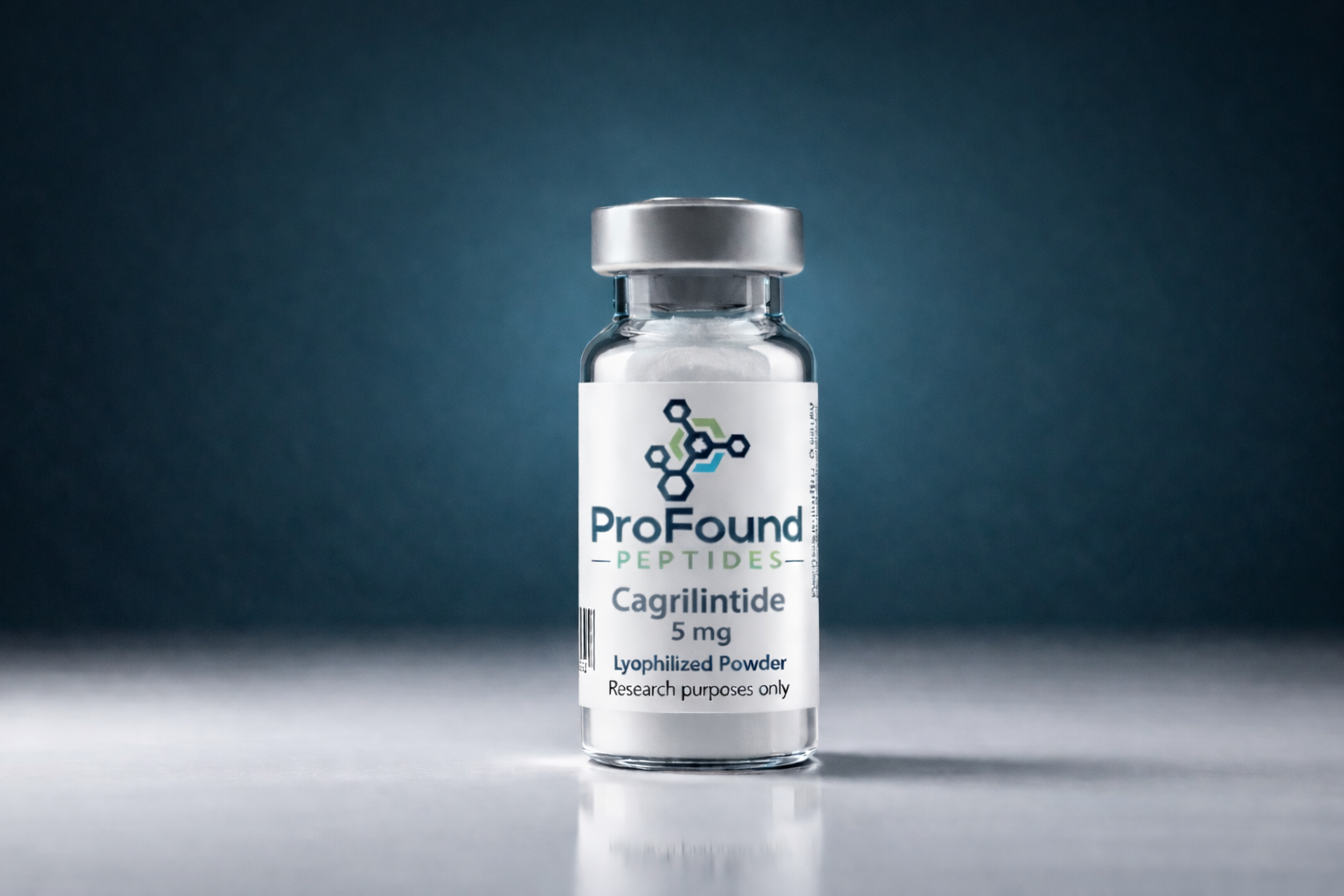
| Also Known As | AM833 / NN9838 / Long-Acting Amylin Analog |
| CAS Number | 1415456-99-3 |
| Molecular Formula | C194H312N54O59S2 |
| Molecular Weight | 4,409.01 Da |
| Sequence Length | 37 amino acids |
| Vial Size (nominal) | 5mg |
| Form | White lyophilized powder |
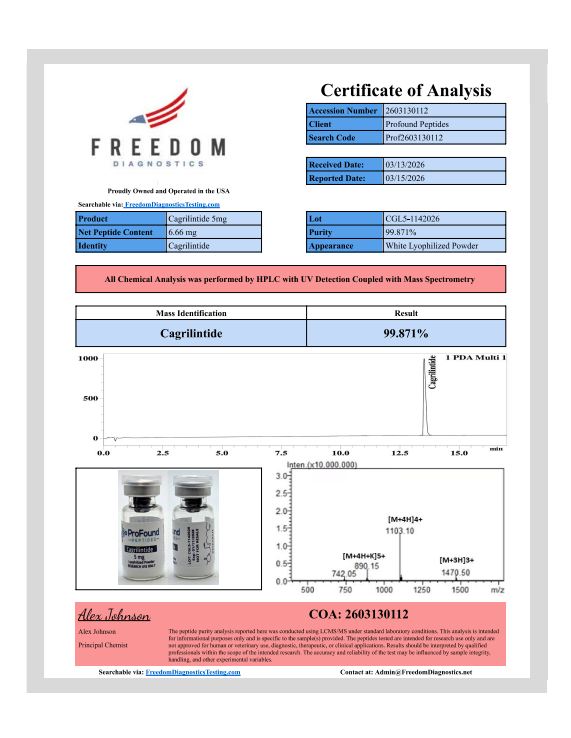
| Purity (this batch) | 99.87% — Freedom Diagnostics COA: 2603130112 |
| Net Peptide Content | 6.66mg confirmed |
| Testing Method | HPLC with UV Detection + Mass Spectrometry |
| Lot Number | CGL5-1142026 |
| Identity Confirmed | Cagrilintide — Mass Spectrometry confirmed |
| Receptor Targets | AMY1R, AMY2R, AMY3R, CTR (non-selective agonist) |
| Half-life | Approximately 159 to 195 hours (6.5 to 8 days) in research models |
| Working Stock | 5mg/mL at 1mL BAC water (approximately 1.33mL usable from 6.66mg net content) |
| Long-term Storage | -20°C, sealed, up to 24 months |
| Post-reconstitution | 4°C, use within 28 days, do not refreeze |
| Reconstitution Solvent | Bacteriostatic water |
| Intended Use | In vitro laboratory research only |
| SKU | PP-628 (5mg single vial). 10-pack variant SKU: PP-629 |
Certificate of Analysis
Freedom Diagnostics is a US-owned independent laboratory. They test every batch without input from Profound Peptides on the outcome. The results below come from the actual report for this lot. Verify them yourself at FreedomDiagnosticsTesting.com before you order.
| Field | Value |
|---|---|
| Purity | 99.871% |
| Testing Method | LC/MS-MS (HPLC with UV Detection + Mass Spectrometry) |
| Identity | Cagrilintide — confirmed |
| Net Peptide Content | 6.66mg |
| Lot Number | CGL5-1142026 |
| COA Accession | 2603130112 |
| Search Code | Prof2603130112 |
| Testing Lab | Freedom Diagnostics (USA) |
| Principal Chemist | Alex Johnson |
| Received | 03/13/2026 |
| Reported | 03/15/2026 |
How Cagrilintide Works
Cagrilintide is built from the human amylin sequence and engineered to solve amylin’s biggest research liability: native amylin aggregates into amyloid fibrils in solution, which makes it unstable and hard to work with experimentally. Cagrilintide keeps amylin’s receptor-binding activity while removing that instability.
Receptor Engagement
Cagrilintide is a non-selective agonist across the amylin receptor subtypes AMY1R, AMY2R, and AMY3R, and it also activates the calcitonin receptor (CTR). That four-receptor binding profile is sometimes described in the literature as a dual amylin and calcitonin receptor agonist, or DACRA. This is a distinct signaling family from GLP-1R, GIPR, or GCGR, so cagrilintide does not overlap mechanistically with incretin peptides like Semaglutide or Tirzepatide. It reaches these receptors through the area postrema and dorsal vagal complex in the brainstem, regions with dense amylin receptor expression and no blood-brain barrier, which is where amylin signaling drives satiety and reduced food intake in research models.
Structural Features That Solve Fibrillation and Extend Half-life
Native human amylin carries two structural problems for lab use: it fibrillates in solution, and it clears the body in minutes. Cagrilintide’s design addresses both. Substitutions at positions 25, 28, and 29, adapted from the naturally non-amyloidogenic rat amylin sequence, reduce the peptide’s tendency to form beta-sheet structures and aggregate. A second pair of substitutions at positions 14 and 17 introduces a stabilizing salt bridge that locks the central alpha-helix in place. A C-terminal proline improves potency at the calcitonin receptor specifically. For half-life, an N-terminal C20 fatty diacid, attached through a gamma-glutamate linker, binds reversibly to albumin in circulation. That albumin binding is what stretches cagrilintide’s half-life out to roughly 159 to 195 hours in research models, a range established by Enebo et al. (Lancet, 2021), supporting once-weekly dosing intervals instead of the minutes-long clearance of native amylin.
Key Structural and Binding Features for Assay Design
| Feature | Detail |
|---|---|
| Receptor targets | AMY1R, AMY2R, AMY3R, CTR (non-selective) |
| Receptor count | 4, no GLP-1R, GIPR, or GCGR activity |
| Fibrillation resistance | Positions 25, 28, 29 substituted from rat amylin sequence |
| Helix stabilization | 14E/17R salt bridge substitution |
| CTR potency | Enhanced via C-terminal proline |
| Albumin binding | Reversible, C20 fatty diacid via gamma-Glu linker at the N-terminus |
| Half-life (research models) | Approximately 159 to 195 hours (6.5 to 8 days) |
| Disulfide bridge | Cys3 to Cys8, preserved from native amylin |
Research Applications
Each bullet states what researchers actually study with this compound and why.
- Amylin and calcitonin receptor pharmacology. Fletcher et al. (J Pharmacol Exp Ther, 2021) characterized cagrilintide’s binding and functional activity across the amylin and calcitonin receptor family and confirmed its non-selective agonist profile. Labs studying this receptor family specifically, rather than the GLP-1 pathway, use Cagrilintide as the reference compound.
- Obesity and body weight regulation models. Lau et al. (Lancet, 2021) ran a dose-finding monotherapy trial across 706 adults and established a clear dose-dependent weight loss and waist circumference response. Rodent diet-induced obesity models use the same dosing logic to study amylin-driven weight regulation independent of incretin signaling.
- Dual-hormone and combination protocol research. Enebo et al. (Lancet, 2021) established the safety and pharmacokinetic profile of Cagrilintide combined with semaglutide 2.4mg in a Phase 1b trial. Studies that model how amylin and GLP-1 signaling interact when co-administered, rather than in isolation, build on this combination framework.
- Appetite and satiety signaling. Amylin receptors sit densely in the area postrema and nucleus tractus solitarius, brainstem regions that process satiety signals independently of the hypothalamic pathways GLP-1 primarily engages. Protocols measuring food intake, meal termination, or central satiety response use Cagrilintide to isolate this signaling arm.
- Fibrillation-resistant peptide engineering reference. Native amylin’s tendency to form amyloid fibrils makes it a difficult peptide to formulate and study directly. Kruse et al. (J Med Chem, 2021) documented the specific substitution and lipidation strategy that solved this, which makes Cagrilintide a useful case study for labs working on aggregation-resistant peptide design more broadly.
- Glycemic control in combination with incretin agonists. Davies et al. (NEJM, 2025) tested the Cagrilintide and semaglutide combination in a type 2 diabetes population and measured glycemic and weight outcomes against each monotherapy. Labs modeling glucose control alongside weight regulation reference this trial design.
How Cagrilintide Compares to Semaglutide for Research
This table targets the comparison queries researchers use when choosing between compounds. Both products are available from ProfoundPeptides.
| Cagrilintide RUO 5mg | Semaglutide RUO 10mg | |
|---|---|---|
| Backbone | Amylin analog | GLP-1 analog |
| Receptor targets | AMY1R, AMY2R, AMY3R, CTR | GLP-1R only |
| Receptor count | 4 | 1 |
| Lipidation | C20 fatty diacid, N-terminal, gamma-Glu linker | C18 fatty diacid, position 26, gamma-Glu/OEG linker |
| Half-life | Approximately 159 to 195 hrs | Approximately 168 hrs |
| Phase of evidence | Phase 2 monotherapy complete, Phase 3 combination trials complete | Phase 3 complete |
| Choose this when | Studying amylin or calcitonin receptor mechanisms, central satiety signaling outside the incretin pathway, or dual-hormone combination protocols | Isolating GLP-1R mechanisms; need a clean single-receptor reference compound |
Storage and Reconstitution
Before You Open the Vial
Pull the vial from -20°C and let it sit at room temperature for 10 to 15 minutes before opening. A cold vial draws condensation when it meets ambient air, and that moisture can reach the lyophilized powder through the stopper before you add your solvent. This one extra step removes a variable before the experiment begins.
Reconstitution Steps
Add 1mL of bacteriostatic water slowly down the inside wall of the vial, not directly onto the powder. Tilt the vial so the stream contacts the glass first. Swirl gently for 30 to 60 seconds until the powder fully dissolves. Do not vortex or shake. The solution is clear when ready. Persistent cloudiness after 90 seconds of gentle swirling means you should request a replacement vial. At 1mL you get a 5mg/mL nominal working stock and approximately 1.33mL of usable solution from the 6.66mg confirmed net content.
Managing the Vial Across a Protocol
This 5mg vial is sized for a focused single-arm use. If your protocol does not use the full working volume in one session, aliquot immediately after reconstitution into single-use volumes and store at 4°C. Use within 28 days. Do not refreeze. If your study needs more than 5mg total, calculate your compound requirement before ordering. The 10-pack option covers larger or multi-arm protocols while keeping every vial on record with its own COA.
| Condition | Guidance |
|---|---|
| Lyophilized, sealed | -20°C, up to 24 months |
| Post-reconstitution | 4°C, use within 28 days, do not refreeze |
| Temperature excursion | Above 8°C post-reconstitution, treat as compromised |
| Condensation risk | Warm vial 10 to 15 minutes before opening |
| Solvent | Bacteriostatic water (sterile saline if BAC water is unavailable) |
Freedom Diagnostics confirmed 6.66mg net peptide content for this lot (COA: 2603130112). The lyophilized material appears as a thin compressed cake at the vial bottom. This is normal at this purity level and does not mean the vial is underfilled.
Published Research
Five studies covering the core Cagrilintide literature. Each entry states what the study actually found, not just that it exists.
| Study | Publication | What it found |
|---|---|---|
| Kruse T et al. (2021)
Peptide development and chemistry |
J Med Chem 64(15):11183
PMID: 34288673 |
Documented the substitution and lipidation strategy that converted amyloid-prone human amylin into a stable, fibrillation-resistant, long-acting analog. The foundational chemistry paper behind cagrilintide’s design. |
| Fletcher MM et al. (2021)
Receptor pharmacology |
J Pharmacol Exp Ther 377(3):417
PMID: 33727283 |
Characterized cagrilintide’s activity across the amylin and calcitonin receptor family and confirmed its non-selective agonist profile at AMY1R, AMY2R, AMY3R, and CTR. |
| Lau DCW et al. (2021)
Phase 2 monotherapy dose-finding |
Lancet 398(10317):2160
PMID: 34798060 |
Established a dose-dependent weight loss and waist circumference response across 706 adults over 26 weeks and defined the dosing range used in later trials. |
| Enebo LB et al. (2021)
Phase 1b combination trial |
Lancet 397(10286):1736
PMID: 33894838 |
Established safety, tolerability, and pharmacokinetics of Cagrilintide combined with semaglutide 2.4mg, the trial that opened the combination program. |
| Garvey WT et al. (2025)
REDEFINE-1, Phase 3 |
NEJM 393(7):635
PMID: 40544433 |
Measured weight loss with the Cagrilintide and semaglutide combination against each monotherapy and placebo at 68 weeks in adults with obesity, with the combination outperforming either compound alone. |
This product is for in vitro laboratory and scientific research use only. Not FDA approved. Not for human consumption, veterinary use, or diagnostic purposes.


Reviews
There are no reviews yet.